
By Sanchit Jain, RO technician and owner of Sanchit Enterprises, Roorkee (since 2014). Updated October 2026.
RO or Aquaguard, which is better? It is one of the most common questions we hear, and it mixes up two different things. Aquaguard is a brand, made by Eureka Forbes. RO, or reverse osmosis, is a type of purification. Aquaguard itself sells RO purifiers, UV purifiers and combinations of both.
The question people really mean is: do I need an RO purifier, or is a UV purifier like the old Aquaguard enough? That depends on your water, and this guide shows you how to decide.
Why people ask RO or Aquaguard
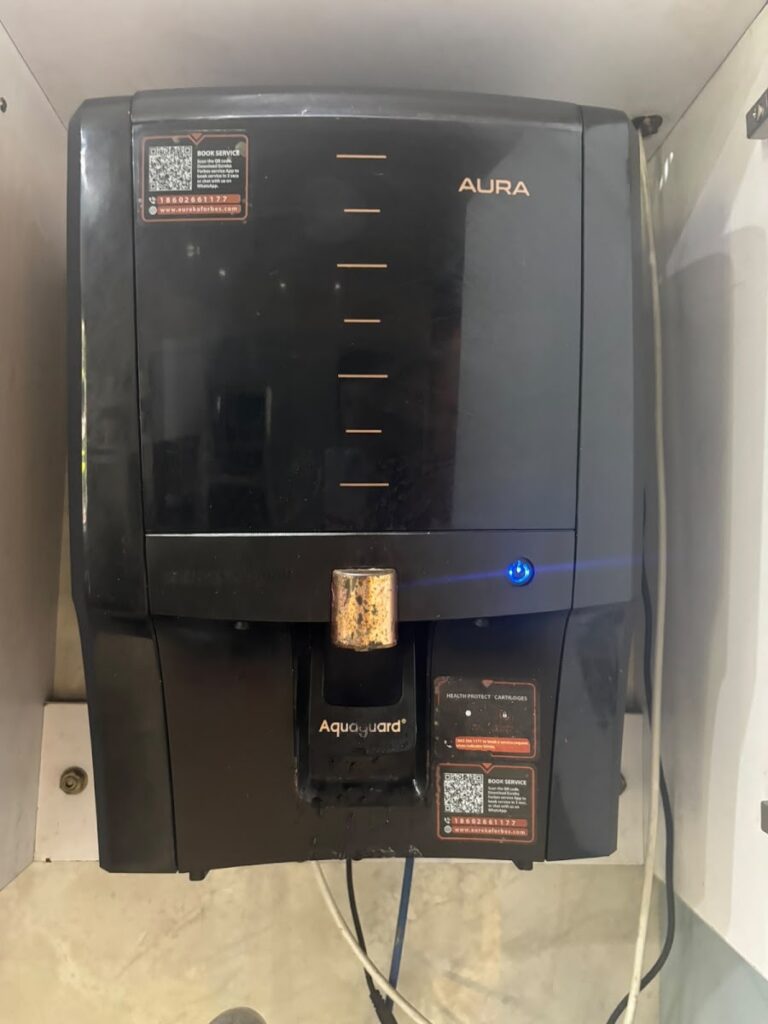
For years the best-known Aquaguard models were UV purifiers, which kill germs with ultraviolet light. So for many families in Roorkee and Haridwar, Aquaguard came to mean a UV purifier, while RO meant the newer, bigger machines. Today that line has gone. Aquaguard models such as the Aura, Ritz and Marvel are RO purifiers, and Kent, Pureit, Livpure and others sell UV-only models too.
So comparing RO or Aquaguard is like comparing petrol or Maruti. The useful comparison is RO vs UV vs UF.
RO vs UV vs UF in plain words
- RO (reverse osmosis): removes dissolved salts, hardness and many heavy metals. Needed when the water has high TDS. Uses electricity and sends some water to drain.
- UV (ultraviolet): kills bacteria and viruses. Does not reduce TDS, salt or hardness. Uses electricity, wastes no water.
- UF (ultrafiltration): removes bacteria, cysts and fine particles with a membrane. Does not reduce TDS. Many UF units work without electricity.
Most purifiers sold today combine them, for example RO+UV or RO+UV+UF, so you get both salt removal and germ protection.
How to decide for your water
Start with a TDS test of your tap or borewell water. India’s drinking water standard, BIS IS 10500, sets 500 mg/L as the acceptable limit for dissolved solids.
- High TDS, salty or hard water (common with borewells): choose RO, ideally RO+UV.
- Low TDS municipal supply that only needs germ protection: UV or UV+UF can be enough.
- Mixed supply, borewell part of the year and municipal the rest: choose RO with a TDS controller, set for the harder water.
If you already own an old UV Aquaguard
Many older homes still run a UV-only Aquaguard. It is fine for low-TDS water as long as the UV lamp works and the filters are changed. But if your home has moved to borewell water, or the water now tastes salty, the purifier cannot fix that, because UV does not remove dissolved salts. That is when to upgrade to an RO.
We service old and new Aquaguard models. See Aquaguard RO service in Roorkee or Aquaguard RO service in Haridwar.
RO or Aquaguard: our verdict
When someone asks us RO or Aquaguard, our answer is: test the water first, then pick the technology, then pick the brand. An Aquaguard RO, a Kent RO or a Pureit RO all do the same basic job. What matters more is that the purifier matches your water, is set correctly, and is serviced on time.
RO or Aquaguard: frequently asked questions
Is Aquaguard an RO purifier?
Aquaguard is a brand. It sells RO, UV and combined purifiers, so some Aquaguard models are RO and some are not.
Which is better for borewell water, RO or UV?
RO, because borewell water often has high TDS and hardness that UV cannot remove.
Does UV purifier remove TDS?
No. UV only kills germs. Only RO reduces dissolved salts.
Can you test my water before I buy?
Yes. We test TDS for free in Roorkee and help you choose.
Need help with your purifier?
Sanchit Enterprises services every RO brand in Roorkee and Haridwar, usually the same day. Call or WhatsApp 096340 98736.
Related: water purifier dealer in Roorkee · Aquaguard RO service · Kent RO service
More RO guides: Best RO brand for home · Which RO service is best? · RO vs alkaline water
